-
Latex and Nitrile Gloves
I used to think it was ok to immerse my hands in solvents or get paint all
over my hands and then wash them in solvent. I've decided that I used to be really stupid. Latex gloves
don't hold up to solvent at all. Even mild solvents such as mineral spirits break down latex very quickly.
Stronger solvents eat latex immediately.
However, I like latex as it gives me the best grip and tactile sensation of
any material from which gloves are made. I use latex when applying paint or when cleaning (degreasing) parts
because degreaser also removes skin oils and makes my skin crack.
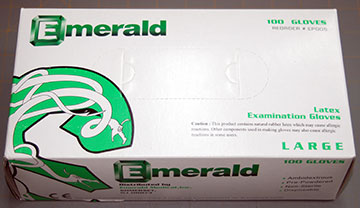
You can buy boxes of 100 gloves (one size fits all) at most hardware stores
for $9.00 to $15.00. One size fits all is usually size medium but the box doesn't say what the actual size is.
If you don't mind gloves that you can get on but don't actually fit right and you don't use a lot of them then that's
probably the way to go.
Because I go through a lot of gloves now I wanted to get them more
economically so I did a web search and found that I can get a case of gloves (ten boxes of 100 gloves) for about half
the price of buying them in the store. Plus they are the right size. You can get them powdered or not.
Powdered are easier to get on but a lot of people don't like the way they feel.
Nitrile gloves stand up to solvents long enough for most tasks. They do swell a bit but as long as they keep the
solvents off your skin that's all that counts. They aren't as rubbery or pliable as latex and I don't care for how
they feel but they work.
-
Markers
Pencils are usually the first choice
for marking wood because the marks can be sanded off easily. Balsa wood is
so soft that it is difficult to mark with a pencil without gouging the wood.
Harder grades of balsa take pencil well, but I usually use a fine point Sharpie permanent marker because it makes a clean, easily seen line.
-
Masking Tape
I go through a lot of
masking tape. I buy cheap tape for general use and for actually masking
paint I use electrician's tape. Masking tape is used for masking things
other than paint. For example, I use it to mask parts that I do not want to
sand when I am trying to bring an adjacent area close to the same size.
Another use for masking tape is to mask the cap strips next to the leading
and trailing edge sheeting of the wing. Once the sheeting is close to its
final shape I remove the tape and finish sand.
I also use masking tape to keep glue from going places I do not want it.
For example when gluing a doubler in the nose of the fuselage I will mask the
fuselage sides to prevent glue from getting all over. Once the doubler has
been put in place and excess glue has squeezed out, I will remove the tape.
-
Mixing cups
One ounce clear plastic mixing cups come in
bags of 50 or 100. You can usually buy them at your local
pharmacy for a reasonable price. Some mail-order places sell
them as well.
-
Pipettes
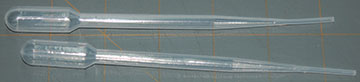
Small plastic bulbs with a tube that can be
used for dispensing paints, solvents and oils by the drop. One
hobby manufacturer sells them 10 for almost $5. The last time I
bought some in an art store (about a year ago) they were about $0.15 a
piece.
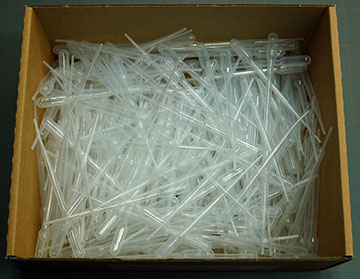
It used to be that I cleaned my pipettes with solvent and pipe
cleaners. It was tedious and the solvent probably cost more than the pipette. I did some searching
and found various places that sell them. I bought 500 for about $50.00 including shipping which comes to
$0.10 a piece. Now I just throw them out.
-
Popsicle sticks
Good for mixing and spreading epoxy.
Scraps of balsa work just as well and you might as well use them if
you've got them. Save the popsicle sticks for when you run out
of scrap balsa you can not use for anything else. You can get
boxes of 1,000 popsicle sticks from a craft store such as Ben Franklin
for a fraction of what the hobby industry charges.
-
Rubbbber Bands
These are the most
unappreciated tools we use. The simple rubber band has a lot of
properties that are very useful to us.
For example, when stretched around something it can create very even
tension or selective unequal tension. What that means is that you
can lift the rubber band from an area and pull it or loosen it to
created localized pressure.
R/Cers think there are two sizes of rubber bands: #64 and others.
If you fly RC and have had a few rubber-band-on wings, then you know
that one size doesn't fit all.
Believe it or not, there are some things to know about rubber bands.
They aren't all created equal, and like anything else, you want to be
sure you're getting decent quality for your money.
Do not buy rubber bands from big office supply stores or Wal-Mart.
They carry the cheapest rubber bands made - less than 60% natural latex
rubber content. These are the kind that when you stretch them you
can actually feel them permanently give - sort of like when you stretch
pull on a garbage bag and it stretches before breaking.
The best rubber bands made are about 90% latex rubber and are excellent.
I don't know if 100% latex rubber bands are manufactured by anyone.
In the past season I've needed a different specific size rubber band on
about five different occasions. I looked for a size chart online
and found a place that sells real sample packs. Each size is in
it's own box listing the contents. They carry several different
sample sets and they were six bucks a piece last time I checked. I
was told all their rubber bands are 90% latex rubber (compared to 60%
and below for rubber bands at Wal-Mart and national office supply
chains).
I went ahead and
ordered all four sets and am extremely pleased with what I got. I
now have a rubber band for every occasion and best of all, I know what
sizes I actually use and can order the right size when I need more
instead of going to Wal-Mart and buying a bag of cheap rubber bands just
to get one that's close enough.
-
Solder
Solder comes in several
types but basically can be broken down into rosin or acid types.
Rosin type solder is used for electrical solder joints because the
rosin will not attack the metal wiring or other components.
If
you use soldering acid, then you must clean up the part after it has
cooled or the acid will cause the metal to corrode. Because it
is difficult to clean the inside of piece of stranded wire, it should
never be used for electrical joints.
I usually use electrical solder for everything including landing gear (joint
is wrapped with wire) and have never had a solder joint fail. If you are
soldering a high-stress joint that is critical to your model then you may want
to consider silver solder.
-
Teflon Tape
Use it for sealing threads on all fittings
attached to your air-compressor or to the air hose.
-
Toothpicks
I use them for applying small amounts of glue
and removing excess glue that squeezes out of joints. They are
also used to pin flat hinges in place so the hinges do not pull out of
the structure. Try to find toothpicks that are actually round.
Most "round" toothpicks are actually square.
-
Waxed Paper, Cling Wrap
and Polyethylene Drop Cloth Material
Used to cover plans to
prevent the structure you are building from being glued to them.
Waxed paper is also used as a release material in various parts of
construction. For example, if you are building a removable part
in place on the structure then using waxed paper or cling film (Saran
wrap) will all the parts to be separated after they are built.
-
Zip Ties
Zip ties are very useful
items to have
around the shop. An assortment of very small to very large are
good for wrapping wires, attaching things to other things, etc.