Airfield Models - How To

Build an All-Wood Landing Gear for a Model Airplane

November 30, 2007


Home
About
What's New
History
Models Gallery
Model Building Safety
Articles
Mail & FAQ
Site Map
Site Feedback
Contact
Register
Add to Favorites
Tell a Friend
Comments
Design and Build Contest
Items For Sale
Search Airfield Models

Back to How-To Articles


Airfield Models (http://www.airfieldmodels.com/)Make an All-Wood Landing Gear for a Model Aircraft

Rustik is a design that is fully sheeted, fiberglassed and painted with clear polyurethane for a natural finish effect.  One goal for this model was to use as little synthetic material as possible.

Throughout the project I had in the back of my mind that eventually I would have to install a landing gear.  I am not real fond of dural aluminum because it bends too easily.  After a while it starts looking ratty from repeated bending back to shape.  With each bend, it bends more easily the next time.

I also do not care for the looks of wire landing gear.  The only other option that I could think of was a carbon-fiber landing gear which would look really out of place on the model.

I thought about making a gear similar to dural aluminum examples, but made from several laminations of thin plywood.  My concerns were weight, strength, stability and durability.  I was confident I could keep the weight within reason, but knew it wouldn't be the lightest gear possible.

As far as stability goes, I wasn't sure it would keep its shape after forming.  There is also the possibility it will begin to warp over time from the weight of the model sitting on it.

In spite of these unknowns, I decided to go ahead and make the landing gear.  It has survived initial flight testing with no problems.  As I learn more about this landing gear, I will post it here.


Make a form to clamp the thin plywood blanks to while the epoxy cures. The gear being built is for a .45 size model.  I was guessing about everything.  The form is made from 1 x 4 lumber with a lite-ply backing to stabilize it.

I cut five blanks from 1/64" plywood.  Not shown in these photos is a lamination of heavy fiberglass cloth that was sandwiched between the bottom-most plywood lamination and the one above it.

The blanks each have a thin coat of laminating epoxy, are aligned and firmly clamped to the form.

The form was covered with wax paper (big mistake) prior to gluing up the laminations.  I used laminating epoxy throughout.  Scraps of plywood and clamps were used to clamp the whole mess together.

I made a plywood plate with the same hole pattern as the blanks to keep the blanks aligned.  The bolts pass through the plate, blanks and form and then thread into blind nuts on the inside of the form.

I put this assembly in the oven at 200° for about 3 hours.  I turned off the oven and left the lay-up in it until the oven had cooled completely.

The finished landing gear will keep it's shape when removed from the form.

The wax paper was stuck to the gear and required a lot of scraping and sanding to remove it.  Other than time it was no big deal because I want the gear to be "weathered" like the inlays in the wing.

Next time I will use some type of plastic instead of wax paper.  I tested a piece of drop-cloth material in the oven at the same temperature and there were no problems.

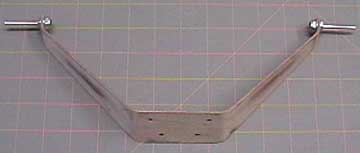
Another view of the finished gear.  You won't see many of these at your field but it was very easy to make.

Another view of the gear.  I could have put on a layer of lightweight glass cloth (top and bottom) during the lay-up process, but I chose not to so I could sand the gear first and get the effect I was looking for.  However, the gear will be glassed with lightweight cloth.

To be honest, I really expected this gear would be a total fiasco.  When I pulled it from the form I expected it to spring out to a ridiculous shape.  To my surprise, the gear maintained its exact shape when removed from the form.  It seems plenty strong and flexible.  My concern now is that if I do one of my patented splatter landings, the gear will break and go through the wing.

When I know more about how this gear performs in service I will let you know.

One last note:  I did not build any toe-in to the form, but it would be easy to sand the lowest portion of the form where the axle will be.  I doubt that toe-in can be added after the fact unless you bend the axle itself.  Trying to use heat to bend the finished gear might damage the glue joints.

When I first mounted the gear on the unfinished model along with the wing and engine the gear seemed to be right at its limit as far as support goes.  I considered building another gear, but instead decided to put the gear back on the form, add a second piece of heavy fiberglass cloth and a sixth lamination of 1/64" ply.  The whole works was clamped back together and put back in the oven.

As I mentioned at the top of the page, the gear has survived the first flight tests but only time will determine it is durability and longevity.


Previous —
Next —

How to Mount a Scale Pilot Bust
How to Add Decorative Inlays to a Model Aircraft

Comments about this article


Back to How-To's
Airfield Models Home


Copyright © 2003 Paul K. Johnson