How
to Make Your Own Plywood
Commercial
plywood is always warped and is available in only a few types.
Working with warped pieces does nothing but make model building more
difficult.
In one case, a kit-supplied plywood former was so warped that I actually
damaged the structure of the fuselage while attempting to get the former
glued in straight and square. It simply did not want to go into place
the way it was supposed to and kept springing back to where it wanted to be.
Eventually I got the former glued in how it should be, but some time
later I jolted the fuselage which caused it to explode (yes, really) due to
internal stresses of parts that required brute force installation.
I learned some valuable lessons that day —
one of which is that kits are crap compared to what can be accomplished by
scratch building (if I take this concept any farther than I have already,
I'll be planting my own balsa and birch trees soon).
This tutorial demonstrates how I make plywood using
balsa wood, but I do
exactly the same thing to make plywood from aircraft ply. Plywood can
be made from any sheet material that can be laminated. The end result
should actually be flat if properly made.
The point of plywood is to have wood that withstands forces coming from more than
one direction unlike regular wood which is weak across the grain. I use plywood to make
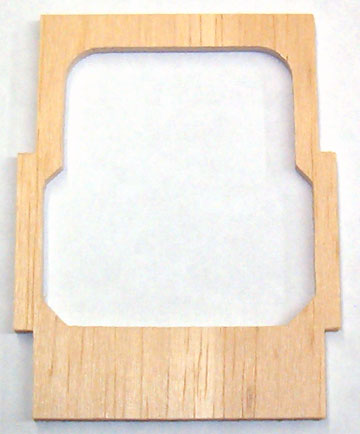
various small reinforcements, such as mounting blocks, as well as formers
having large cut-outs.
Avoid the use of large slabs of plywood because it is heavy and there is
almost always a better method to reinforce larger areas.
Also see
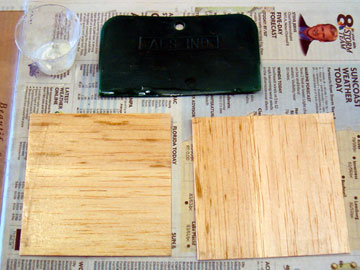
Tools and Materials
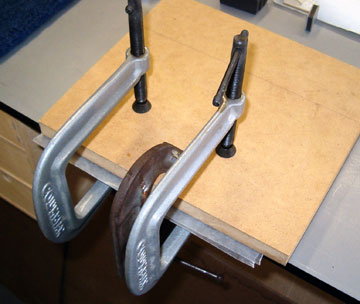
- A hard, flat surface
- A hard, flat board or piece of glass
- Weight or clamps
- Wood to make the plywood
-
Epoxy or
polyurethane glue
- Squeegee
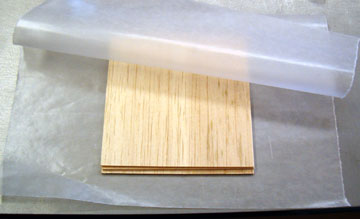
- Wax Paper
|