Disorientation
Phenomenon when Flying Radio Control Aircraft
Whenever I mention the problem of becoming disoriented to a beginner or
someone who is not involved with the hobby it always appears as if the
extent of the problem doesn't sink in. I think a lot of people believe
that it can't happen to them. Any experienced R/C pilot will confirm
that disorientation is a very real problem.
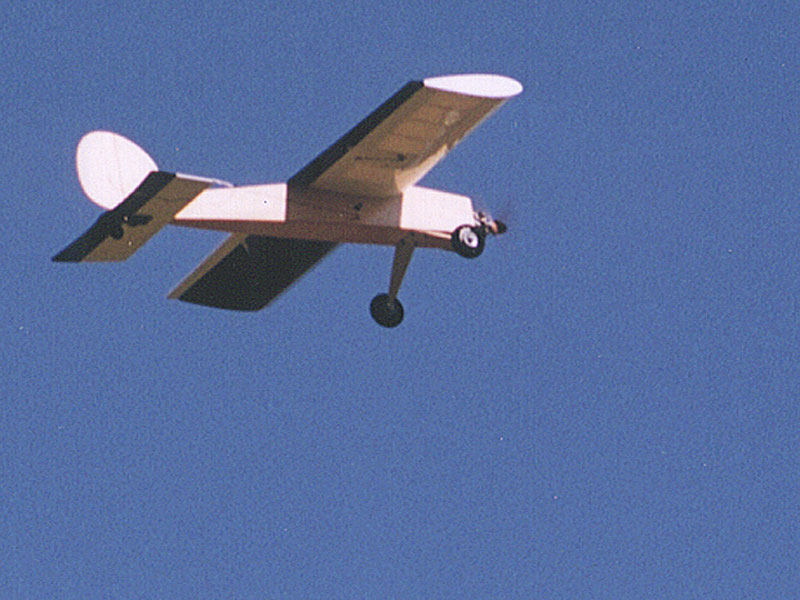
Disorientation simply means that the model looks like it is going one
way when in fact it is going in another direction altogether. You
might think that if you keep the plane in close then it won't be possible to
become disoriented. That simply isn't true. One can become
disoriented regardless of the distance the model is from the pilot.
I still lose orientation of my models and have been flying for more years
than I want to think about. When I lose orientation with the model at
a higher altitude it doesn't trouble me too much because I can slow the
model down and work it out by moving the controls and watching what the
model does in response.
More disconcerting is becoming disoriented when the model is at a lower
altitude. If you find out that the model really is going in a
different direction than you think it is then you may not have time to do
anything about it before it's in the ground.
I was watching my buddy Mike fly
Thwing! the other day. Every time he made a turn at one end of the
field I could swear he was turning the model away from the field when in
fact he was turning the model back toward the field. After the first
time I was fooled I paid closer attention to the model.
Each time he turned the model in the same area what I saw was the model
going in the opposite direction. It was an optical illusion that would
have caused me to lose the model had it happened when I was flying it.
Fortunately, Mike was at the controls and not having the same problem.
Do not panic when you become disoriented
The model is probably going the way you think it should be going regardless
of the message your eyes are sending to your brain. You can have
confidence that the model is most likely on the course you last set it on
unless the model flew through some funny air that flipped the airplane over.
Do not give any abrupt or prolonged control inputs. Wiggle the
ailerons or elevator gently and watch what the aircraft does. The
response of the model should give you clues as to what its attitude is.
Situational awareness is always helpful. Before you take off
your model you should know who else is flying and who is standing nearby
your pilot station. If you become disoriented call out to someone by
name and tell him of your predicament. He will most likely be able to
tell you in which direction the model is heading.
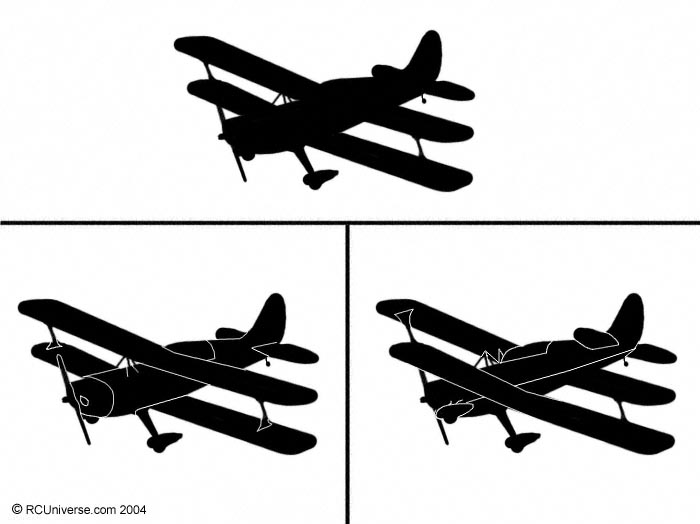
The graphic that follows is provided courtesy of
RC Universe.
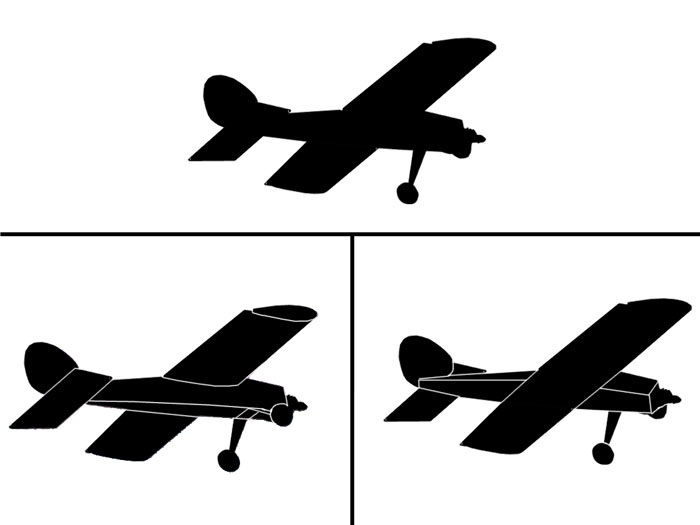
This image should make it strikingly clear how one can become disoriented.
Look at the pictures carefully. All three images can be superimposed
directly over each other.
 |